Box Modelling
Box modelling is a technique in 3D modelling where you take a basic primitive shape (like a box, cylinder or others) and make the basic shape “rough draft” of your final model from there you sculpt out your final model. The process uses various tools and steps that sometimes get repeated again and again until you're done. Despite the fact you’re repeating these steps you will model faster and control the amount of detail you wish to add, slowly building your model up from ground level of detail to high level.http://en.wikipedia.org/wiki/Box_modelling
Extrusion Modelling
Although it is necessary to keep in mind how the geometry will develop, extrusion modelling allows for a lot of freedom in where you place vertices at the beginning of the modelling process. In this example, it enables you to trace the outline of a photograph closely.
http://my.safaribooksonline.com/book/animation-and-3d/9780470102602/working-with-meshes/extrusion_modeling_and_box_modeling
Primitive Modelling
Primitives are the building blocks of 3D-basic geometric forms that you can use as is or modify with transforms and Booleans. Although it's possible to create most of these objects by lathing or extruding 2D shapes, most software packages build them in for speed and convenience.
Common 3D Primitives: Cube, Cylinder, Tube, Sphere, Torus, Cone
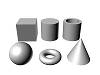
http://www.peachpit.com/articles/article.aspx?p=30594&seqNum=5
Specialised Modelling
In 3D computer graphics, polygonal modeling is an approach for modeling objects by representing or approximating their surfaces using polygons. Polygonal modeling is well suited to scanline rendering and is therefore the method of choice for real-time computer graphics. Alternate methods of representing 3D objects include NURBS surfaces, subdivision surfaces, and equation-based representations used in ray tracers. See polygon mesh for a description of how polygonal models are represented and stored.
http://en.wikipedia.org/wiki/Polygonal_modeling

No comments:
Post a Comment